AI Agents: The Final Frontier of the Enterprise
By CxO Institute Marketing
The Age of Agentic
Agentic AI is emerging as a transformative force in the business landscape, redefining how
organizations operate and innovate. Unlike traditional artificial intelligence (AI) systems that
focus on data analysis and providing recommendations, Agentic AI, also referred to as AI
agents, represents a new frontier.
AI agents are GenAI solutions that can make autonomous decisions and perform actions to
achieve an objective. This differs from AI assistants, which are typically chatbots like ChatGPT
that have limited autonomy in assisting users by performing tasks, providing information, or
facilitating processes, and AI copilots, which have some autonomy in working alongside a user
to enhance productivity and support decision-making processes.
This means AI Agents possess the capability to act autonomously, make decisions, and
execute tasks independently based on their understanding, goals, and adaptive learning.
This ability to operate without constant human oversight introduces unprecedented levels of
efficiency, agility, and scalability.
As businesses face increasing demands for speed, personalization, and innovation, the
adoption of Agentic AI is accelerating across industries. Organizations are leveraging its
capabilities to optimize operations, automate complex processes, and enhance customer
experiences. From streamlining supply chains to delivering real-time, adaptive solutions,
Agentic AI is reshaping the competitive landscape.
AI Agents Create Value and Trust
Enterprises have already recognized the immense business value of GenAI since its emergence,
delivering tangible business benefits by improving employee productivity and optimizing
processes across departments. In fact, 90% of ITDMs surveyed stated that their organization
has already effectively leveraged GenAI technologies as part of its IT strategy.
In line with this, forward-thinking technology leaders are now looking to AI agents as the next
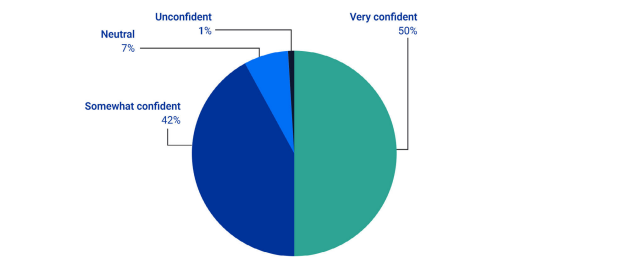
phase of their AI strategies. Currently, 50% of ITDMs report their organization is already using
AI agents, with a further 32% planning to implement AI agents in the coming years (Fig. 1).
A strong majority of ITDMs are also confident in the potential of AI agents, with 92% believing
that deploying these technologies will lead to meaningful business outcomes within the next
12-18 months
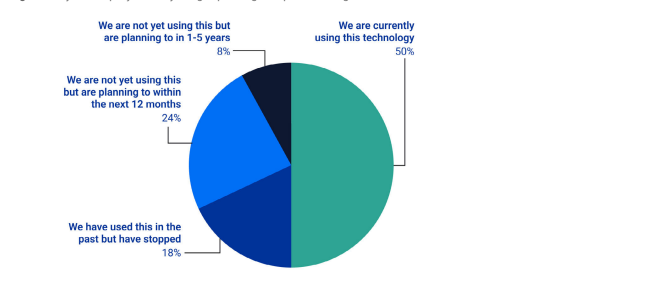
How confident are you that if you deploy AI agents, they would deliver meaningful business outcomes
in the next 12-18 months?
Spirent Communications, the leading provider of test and assurance solutions for next-
generation devices and networks, was looking to transform a manual time intensive process
that forced business intelligence and sales teams to spend several hours per day on manual
go-to-market tasks.
The Spirent team leveraged the power of AI Agents for an internal sales intelligence tool
that delivered pre-synthesized, summarized customer and competitive information for sales
and support teams. This was a process that previously took team members more than eight
hours per week to complete manually. In the first ninety days after deployment, Spirent saw
a 25% increase in business intelligence worker productivity and is expecting a 5% increase in
Sales productivity. The team also expects to save $144,000 annually by consolidating AI user
subscription fees.
As Agentic AI technology has matured and companies have gained experience, enterprise
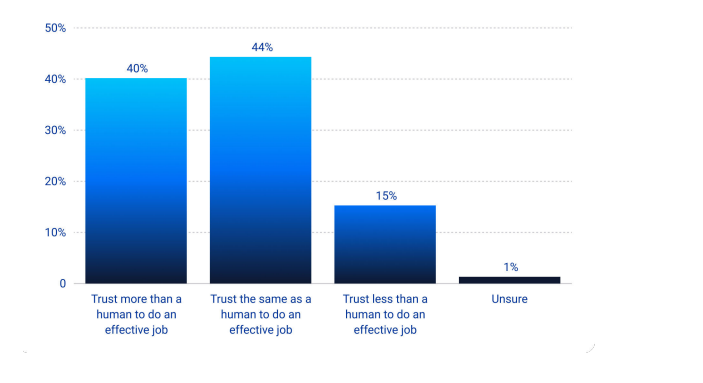
leaders are increasingly placing their trust in Agentic AI to drive effective outcomes. When
asked, 84% of respondents reported they trust AI agents just the same, if not more than
a human to perform a given task effectively (Fig. 3), reflecting growing confidence in the
technology’s reliability and capabilities. This trust underscores the recognition of AI agents’
ability to execute tasks with precision, consistency, and scalability, which are critical in today’s
fast-paced business environments.
Diving into Deployment
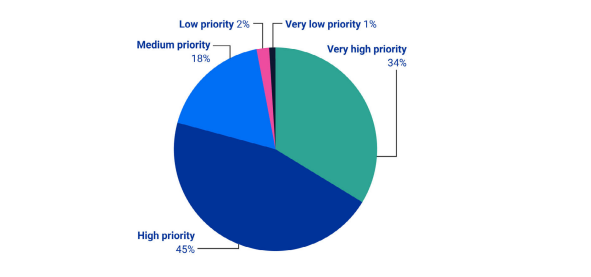
Currently, 79% of respondents report that implementing and deploying AI agents is a key focus
in the coming year (Fig. 4), underscoring the widespread belief that AI will play a pivotal role
in enhancing operational efficiency, automating complex tasks, and delivering meaningful
business outcomes.
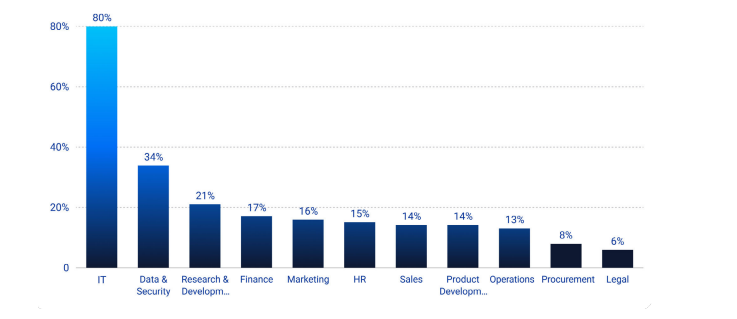
When looking at where AI agents will have the biggest impact within the organization, ITDMs
overwhelmingly name the IT department as the area to see the largest benefit, with 80%
highlighting them as the primary beneficiaries of AI agents. This is followed by data & security
teams and research & innovation teams
Given that IT teams currently dedicate an average of 16 hours per week to building, deploying,
integrating, and fixing AI technologies, it’s perhaps then unsurprising that the IT department
expects to see the greatest benefit, as the adoption of Agentic AI is expected to dramatically
reduce this workload. Respondents to this research anticipate that AI agents will save an
average of 19 hours per week, allowing IT teams to focus on higher-value tasks, such as
strategic innovation and improving system performance, rather than routine maintenance and
troubleshooting.
The finance team is the first non-technical team that respondents believe would benefit the
most from AI agents, highlighting the impact agents have on reducing repetitive tasks and
supporting critical activities such as financial forecasting and reconciliation.
Independent Bank is a Michigan-based bank holding company with total assets of
approximately $5.3 billion. During a recent software outage, the IT team established an
“IT command center” to update AI Agent endpoints in real time. This enabled proactive
communication with users via voice and chat, informing them of the system downtime.
These measures prevented issues from escalating into help desk calls or tickets, resulting in
an average 20% reduction in calls from the voice AI Agent service. This figure is expected to
improve even further as actionable services are added to manage password resets, system
restarts, and other commonly requested tasks.
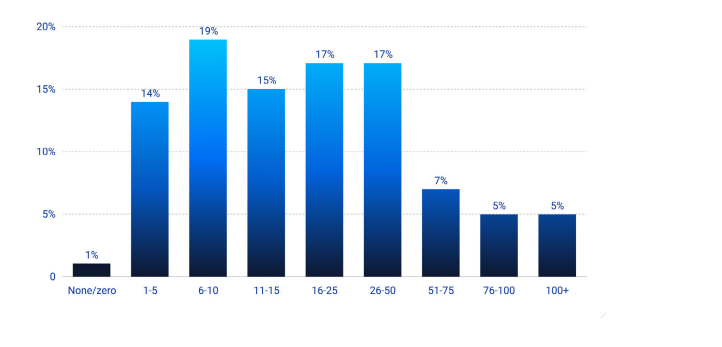
In light of these benefits, it’s unsurprising that organizations are increasingly integrating
AI agents into their operations, with an average of 32 AI agents currently deployed across
enterprises. This adoption is set to accelerate, as companies plan to deploy an additional 30
new AI agents on average within the next 12 months
This growth reflects the widespread recognition of AI agents’ ability to streamline processes,
automate tasks, and enhance decision-making, helping businesses become more efficient and
agile in an increasingly competitive environment. As the deployment of AI agents expands,
organizations are positioning themselves to unlock further operational efficiencies and gain a
strategic edge.
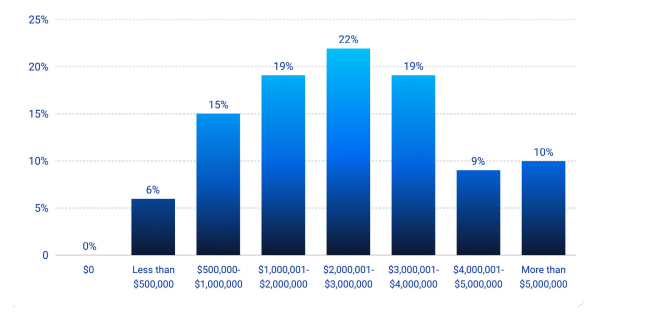
Investment in AI agents is a top priority for many organizations, with an average spend of
$2,559,750. In fact, 79% of organizations are planning to allocate over $1 million toward
developing and deploying these technologies over the next 12 months, with 38% allocating over
$3 million and 10% over $5 million (Fig. 7). This significant financial commitment highlights the
growing recognition of AI agents as a critical tool for driving business transformation.
Interestingly, those in Australia are likely to invest more in AI Agents in the coming year, than
the other markets studied. Australian organizations are set to spend an average of $3,151,667,
compared to an average spend of $2,566,000 in German organizations, $2,508,571 in US
organizations and $2,270,000 in UK organizations.
The fact respondents highlighted Agentic AI as both a strategic priority and receiving significant
financial investment for the coming year, demonstrates the increasing importance of AI agents
in shaping the future of enterprise operations.
Overcoming Barriers
But despite this enthusiasm, there are still significant barriers to adoption for many. These
obstacles stem from a combination of technological, organizational, and cultural challenges
that inhibit deployment.
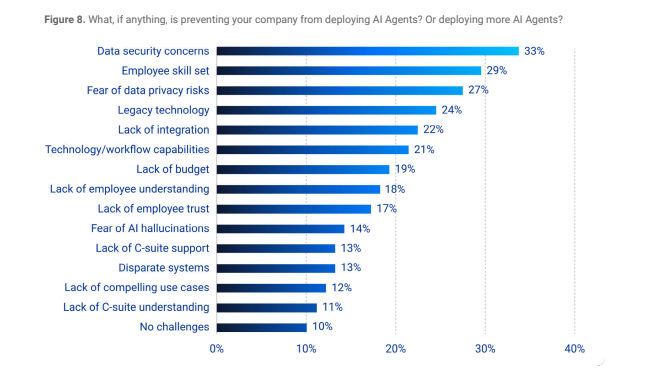
The foremost concern is data security and privacy, cited by 60% of respondents (Fig. 8).
Businesses handling sensitive information are wary of potential vulnerabilities that Agentic
AI systems could introduce, particularly when these systems operate autonomously with
less human oversight. Ensuring compliance with stringent regulations further complicates
deployment.
In partnership with SnapLogic